
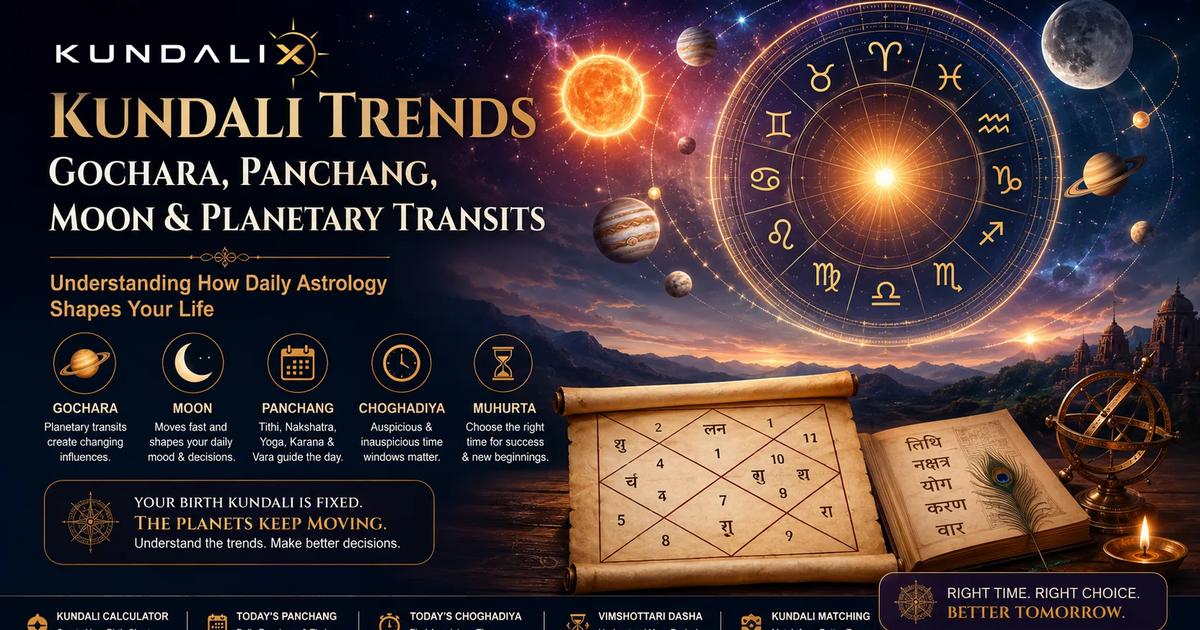
Your birth Kundali is a snapshot of the sky at the exact moment and place you were born. The planetary positions recorded in that chart become the foundation for Vedic astrology interpretation.
But the planets do not stop moving after your birth.
As the planets travel through the zodiac, their current positions create changing Gochara, or planetary transit conditions. At the same time, daily Panchang elements such as Tithi, Nakshatra, Yoga, Karana and Vara continue to change according to astronomical movements and local time.
This is the basic idea behind Kundali trends: your natal chart remains fixed, while the planetary environment around it keeps changing.
Whether you are checking Kundali Today, today's Panchang, Moon Sign, Nakshatra, Choghadiya or planetary transits, the exact date, time and location can make a significant difference.
What Are Kundali Trends?
Kundali trends refer to the changing planetary and time-based conditions that can be viewed in relation to a person's natal Kundali.
Your birth chart is calculated from three essential details:
Date of Birth + Exact Birth Time + Birth Location
A current astrology calculation uses another question:
Where are the planets now, and how do their current positions relate to the birth chart?
This distinction is important.
Your natal chart does not need to be recreated every day. Instead, current transits are compared with the fixed birth chart to understand which areas of life may be emphasized according to traditional Vedic astrology.
New to Jyotish? Explore the Vedic Astrology Basics guide to understand signs, planets, houses, Lagna and divisional charts.
Birth Kundali vs Current Planetary Transits
Think of your natal Kundali as a permanent map and planetary transits as the changing conditions moving across that map.
Birth Kundali
A natal Kundali records planetary positions at birth, including:
Lagna (Ascendant)
Sun
Moon
Mars
Mercury
Jupiter
Venus
Saturn
Rahu
Ketu
A complete Vedic chart can also include the D1 Lagna chart, D9 Navamsha chart, Moon chart and Chalit chart.
You can generate your own chart using the KundaliX Free Kundali Calculator.
Planetary Transits
Transits represent the current positions of the planets.
Because each planet moves at a different speed, some trends develop quickly while others unfold over months or years.
The Moon moves comparatively quickly, while planets such as Jupiter and Saturn create much longer transit cycles.
This is why there is no single “Kundali trend” that changes at the same speed throughout the day.
What Is Gochara in Vedic Astrology?
Gochara is the traditional Vedic astrology concept of planetary movement through the zodiac.
In a transit analysis, the current position of a planet is compared with the natal chart. Astrologers may examine its relationship with the Ascendant, Moon sign, houses and natal planets.
Different planets create different timescales.
The Moon is especially important for short-term and daily observations because of its relatively rapid movement.
The Sun moves through approximately one zodiac sign each month.
Mercury and Venus generally move more quickly through the zodiac, although retrograde periods can alter their apparent motion.
Mars, Jupiter and Saturn create longer-running transit themes.
Rahu and Ketu, the lunar nodes used in Vedic astrology, are also commonly considered in longer-term transit analysis.
This range of planetary speeds is why a daily astrology reading and a long-term Gochara analysis can look very different.
Why the Moon Matters in Daily Kundali Trends
The Moon is one of the most important factors in daily Vedic astrology.
Its position changes continuously, affecting the exact lunar degree and, at appropriate boundaries, the Rashi or Nakshatra being used in a calculation.
The Moon is also central to several Panchang calculations.
This makes the current Moon position particularly relevant when searching for:
Moon Sign Today
Today's Nakshatra
Nakshatra Today
Daily Kundali
Panchang Today
A Moon transit should always be calculated for the correct date, time and location, especially when it is close to a sign or Nakshatra boundary.
What Is Lagna?
The Lagna, or Ascendant, is the zodiac sign rising on the eastern horizon at a particular moment and location.
Unlike the natal Lagna, which is fixed by your birth details, the current Ascendant keeps moving throughout the day.
The Ascendant often remains in a sign for roughly two hours, but the actual duration can vary according to location and astronomical conditions.
This is why exact birth time is so important when creating a Kundali.
A small difference in time can matter even more when the Ascendant is close to a sign boundary.
For a clearer explanation of how Lagna, houses and signs work, visit the KundaliX Vedic Astrology Basics.
How Panchang Connects With Kundali Trends
A Panchang is a traditional Hindu almanac built around five key elements:
Tithi — lunar day
Vara — weekday
Nakshatra — lunar mansion
Yoga — Sun-Moon combination
Karana — half of a Tithi
These five elements are used to describe the changing qualities of time.
Unlike a simple calendar in which every moment of a date appears identical, Panchang calculations recognise that astronomical conditions change throughout the day.
KundaliX provides a dedicated Today's Panchang page where users can check daily Panchang information along with important time-based calculations.
Because sunrise and sunset depend on geography, Panchang timings should be calculated for the relevant city rather than copied from a different location.
Tithi: The Lunar Day
Tithi is calculated from the angular relationship between the Sun and Moon.
There are 30 Tithis in a lunar month, divided between Shukla Paksha and Krishna Paksha.
Because the Sun and Moon continue moving, Tithi transitions occur at specific astronomical times.
Therefore, the Tithi active at the beginning of a calendar date is not necessarily the same Tithi that remains active throughout the entire day.
Checking a location-specific Panchang Today is the best way to determine the relevant Tithi and its transition time.
Nakshatra: The Moon's Lunar Mansion
Vedic astrology divides the zodiac into 27 Nakshatras, also called lunar mansions.
The Nakshatra occupied by the Moon is important in several areas of Jyotish, including birth-chart interpretation and traditional timing systems.
The Moon moves through the Nakshatras during its monthly cycle, so the active Nakshatra changes with time.
Near a Nakshatra or Pada boundary, the exact calculation time becomes particularly important.
The Moon's birth Nakshatra also plays an important role in calculating Vimshottari Dasha, another major timing system used in Vedic astrology.
Choghadiya and Daily Muhurta
Choghadiya is a traditional system for dividing daytime and nighttime into a sequence of time periods.
The timing of each Choghadiya is calculated from local sunrise and sunset, which means the exact clock times vary according to location and date.
The periods commonly include:
Amrit, Shubh, Labh, Char, Udveg, Rog and Kaal.
Traditionally, Amrit, Shubh and Labh are generally viewed as favourable periods for certain activities, while Udveg, Rog and Kaal are often avoided for many new beginnings.
However, the suitability of a time depends on the activity and the broader Muhurta framework.
You can check the current timings through Today's Choghadiya on KundaliX. The page calculates the periods from the actual local sunrise and sunset rather than treating every Choghadiya as a fixed 90-minute clock block.
Rahu Kaal and Location-Based Timing
Rahu Kaal, also known as Rahu Kalam, is another commonly checked daily period in the Panchang tradition.
Its exact clock time changes according to the weekday and the local daylight interval.
As a result, Rahu Kaal in Delhi may not occur at exactly the same clock time as Rahu Kaal in Mumbai, London or Singapore.
For accurate daily timing, check the location-specific KundaliX Panchang instead of relying on a generic time copied from another location.
Why Your Birth Kundali Does Not Change
One of the most common questions in astrology is whether a Kundali changes over time.
Your natal Kundali does not change.
It is calculated from the planetary positions at your birth moment.
What changes are the planets' current positions.
For example, Jupiter may transit from one sign to another years after your birth, Saturn may enter a new sign, and the Moon may change signs within days.
These movements are then compared with your original Kundali.
A useful way to think about it is:
Birth Kundali = Fixed foundation
Gochara = Current planetary movement
Panchang = Daily qualities of time
Dasha = Planetary timing periods
Together, these provide different layers of the traditional Vedic astrology framework.
Short-Term and Long-Term Kundali Trends
Not every astrological trend operates on the same timeline.
Daily Trends
The Moon, Tithi, Nakshatra, Yoga, Karana, Choghadiya and other Panchang elements can change within a day.
These are especially useful when someone is checking daily astrology or selecting a time for an activity.
Monthly Trends
The Sun changes signs approximately once a month, creating broader monthly transit themes.
Mercury and Venus can also move relatively quickly compared with slower planets.
Long-Term Trends
Mars, Jupiter and Saturn can create longer-lasting transit patterns.
Rahu and Ketu are also examined in longer transit cycles.
This is why a meaningful Kundali trend should be interpreted according to the planet involved instead of assuming every transit works on a daily timescale.
Kundali Trends and Vimshottari Dasha
Planetary transits are only one part of predictive Vedic astrology.
Another important timing framework is Vimshottari Dasha.
Vimshottari Dasha is based on a symbolic 120-year sequence divided among nine planetary rulers. The starting planetary period is determined from the Moon's Nakshatra at birth.
The major period is called the Mahadasha, and its subdivisions are known as Antardasha or Bhukti.
This creates a timing framework that can be considered alongside planetary transits.
Learn more with the KundaliX Vimshottari Dasha Guide. It explains the planetary sequence, starting Dasha and Mahadasha–Antardasha structure.
Why the Same Transit Can Affect People Differently
A planetary transit occurs in the sky for everyone, but its traditional interpretation can differ from one birth chart to another.
The reason is simple: people have different Ascendants, Moon signs, house structures and natal planetary placements.
For example, one person's Jupiter transit may activate a particular house while the same transit falls into another house for someone with a different Ascendant.
This is why a personalised Kundali analysis is different from a generic daily horoscope.
Rather than asking only:
“What is Jupiter doing today?”
traditional transit analysis also asks:
“Where is Jupiter relative to this person's birth chart?”
How to Read Your Current Kundali Trends
A practical approach is to layer the information.
First, generate your natal chart using your exact date, birth time and location.
Then identify your Lagna and Moon sign.
Next, examine the current planetary positions and their relationship with your birth chart.
After that, check the day's Panchang.
When selecting a specific time, review the local Choghadiya, Rahu Kaal and relevant Muhurta factors.
This produces a much richer picture than relying on one planetary position or a generic daily horoscope.
KundaliX: Your Vedic Astrology Toolkit
KundaliX brings several important Vedic astrology tools together in one place.
Free Kundali Calculator
Generate a Vedic birth chart from your exact birth details, including D1 Lagna, D9 Navamsha, Moon and Chalit charts. KundaliX calculates the chart using the Swiss Ephemeris.
Today's Panchang
Check Tithi, Nakshatra, Yoga, Karana, Vara, Rahu Kalam, Yamaganda, Gulika Kalam, Brahma Muhurta and other daily timings for a selected location.
Today's Choghadiya
Check day and night Choghadiya periods and identify traditionally auspicious and inauspicious windows.
Vimshottari Dasha Guide
Understand Mahadasha, Antardasha and the 120-year planetary timing system.
Kundali Matching
Compare two birth charts using traditional Guna Milan principles and explore compatibility factors such as Manglik Dosha.
Frequently Asked Questions
What are Kundali trends?
Kundali trends describe changing planetary, lunar and Panchang conditions that can be examined alongside a fixed natal birth chart.
Does a birth Kundali change?
No. A natal Kundali is based on the planetary positions at your birth. Current planetary transits change, but your original birth chart remains fixed.
What is Gochara?
Gochara is the traditional Vedic astrology concept of planetary movement or transit through the zodiac and its relationship with a natal chart.
Why is the Moon important in daily astrology?
The Moon moves relatively quickly and is central to several daily astrology and Panchang calculations, making it an important short-term indicator in traditional Jyotish.
Why do Panchang timings differ between cities?
Sunrise, sunset and other astronomical calculations vary by geographic location, so Panchang and associated time windows can differ between cities.
Is Choghadiya the same as Panchang?
Choghadiya is commonly included in daily Panchang resources, but traditionally the word Panchang refers specifically to five elements: Tithi, Vara, Nakshatra, Yoga and Karana.
Does the Lagna change throughout the day?
Yes. The current Ascendant continuously changes as Earth rotates, and it generally moves through a zodiac sign over a period of roughly a couple of hours, with the exact duration depending on location.
Is Gochara enough for a complete prediction?
Traditional Vedic astrology generally considers transits alongside the natal chart and other timing systems such as Vimshottari Dasha. A single transit should not normally be treated as a complete prediction by itself.
Final Thoughts
Your birth Kundali is fixed, but the planetary sky is always moving.
That movement creates the changing conditions behind daily astrology: Gochara, Moon sign, Nakshatra, Panchang, Choghadiya, Rahu Kaal and planetary transits.
The best way to understand Kundali trends is to view these changing factors alongside the permanent foundation of your natal chart.
For accurate calculations, use your exact birth details when creating your Kundali and the correct local date, time and location when checking Panchang, Choghadiya or other current astronomical calculations.
Start with the KundaliX Kundali Calculator, check Today's Panchang, or explore Today's Choghadiya.
Related KundaliX Resources
Vedic Astrology Basics — Learn about planets, houses, Rashis and divisional charts.
Free Kundali Calculator — Generate your Vedic birth chart.
Today's Panchang — Check daily Tithi, Nakshatra and Panchang timings.
Today's Choghadiya — Find auspicious and inauspicious Choghadiya periods.
Vimshottari Dasha Guide — Understand planetary periods and predictive timing.
Kundali Matching — Compare two Kundalis using traditional compatibility principles.