
Raksha Bandhan 2026: Why This Year Is Astrologically Significant
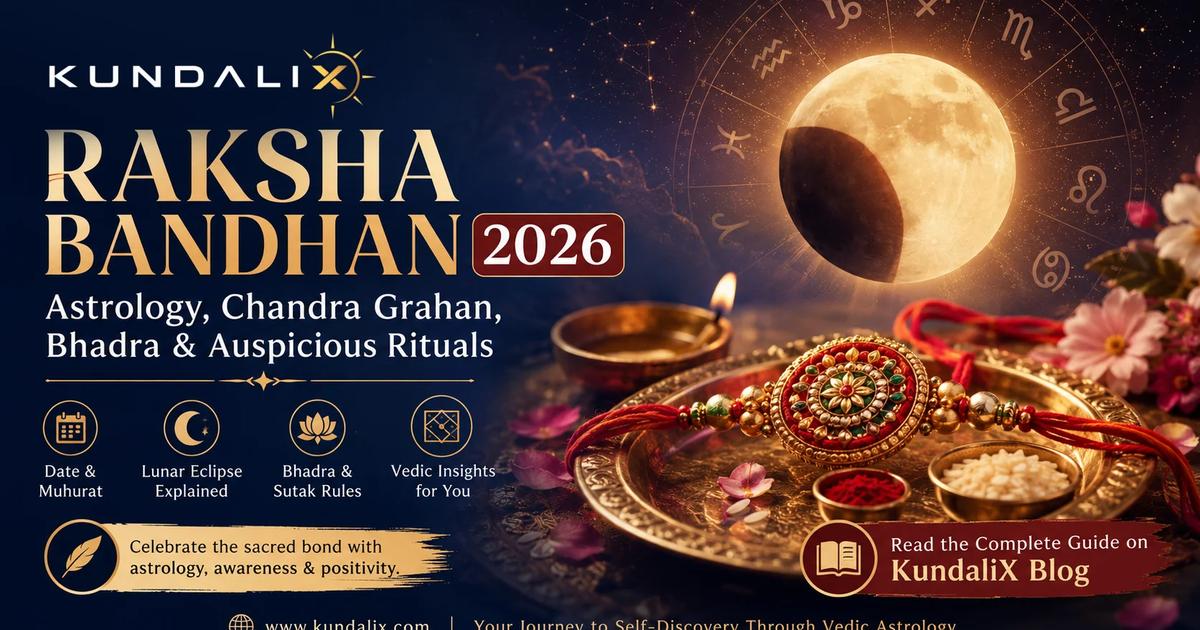
Raksha Bandhan is one of India's most meaningful festivals, celebrating the bond of protection, affection and responsibility between brothers and sisters. In 2026, the festival has an additional astrological significance because Raksha Bandhan falls on Friday, August 28, around the same time as a partial lunar eclipse.
The combination of Shravana Purnima, Raksha Bandhan and a lunar eclipse has created considerable interest among people who follow Vedic astrology and traditional Panchang practices.
For anyone asking, "When is Raksha Bandhan 2026?", the festival will be observed on August 28, 2026 in India. The confusion around August 27 and 28 comes from the timing of the Purnima Tithi, which spans the two dates. Traditional festival observance generally follows the relevant tithi and local Panchang rules.
The lunar eclipse is also attracting attention because it occurs around the same Purnima. However, eclipse visibility and traditional observances should not be confused with astronomical facts. The 2026 lunar eclipse is not visible from India, which is important when considering traditional Sutak rules.
Raksha Bandhan 2026 Date and Purnima Tithi
Raksha Bandhan is traditionally observed on Shravana Purnima, the full-moon day of the Hindu month of Shravana.
In 2026, Raksha Bandhan will be celebrated on Friday, August 28.
Because the Purnima Tithi extends across August 27 and August 28, different calendars may display the beginning of Purnima differently. This is why checking a location-specific Panchang is preferable to relying on a generic calendar.
For religious ceremonies, the exact local timing can depend on:
- Purnima Tithi
- Bhadra period
- local sunrise and sunset
- regional Panchang traditions
- the type of ritual being performed
For this reason, people looking for an exact Rakhi Muhurat 2026 should check the Panchang for their city before performing the ceremony.
Chandra Grahan on Raksha Bandhan 2026
One of the most discussed aspects of Raksha Bandhan 2026 is the lunar eclipse occurring on the same date.
Astronomically, the August 28 event is a partial lunar eclipse. Reports based on astronomical calculations indicate that the eclipse will not be visible from India because the Moon is below the horizon during the relevant eclipse period.
This distinction matters.
An astronomical eclipse is an observable celestial event. Traditional astrological and religious practices surrounding an eclipse are cultural and scriptural interpretations. Therefore, people should avoid treating every traditional eclipse belief as a scientifically established effect.
For Vedic astrology enthusiasts, however, an eclipse occurring around Purnima can be considered an important symbolic event for reflection, spiritual practices and examination of one's emotional patterns.
Does Sutak Apply in India for Raksha Bandhan 2026?
This is one of the biggest questions surrounding Raksha Bandhan this year.
Traditional Hindu practice often associates Sutak with an eclipse. However, many Panchang traditions use visibility from a particular location when determining whether eclipse-related Sutak observances apply.
Since the August 28, 2026 lunar eclipse is not visible from India, many astrology and Panchang sources state that Sutak does not apply in India.
However, regional customs can differ.
Therefore, if your family follows a particular Sampradaya, temple tradition or local Panchang, it is reasonable to follow that established practice rather than applying a generalized rule from the internet.
What Is Bhadra and Why Does It Matter for Rakhi?
Bhadra is a period associated with Vishti Karana, one of the Karanas used in the Hindu Panchang.
Traditional Muhurta practices generally avoid beginning certain auspicious activities during Bhadra. This is why Bhadra is frequently mentioned when determining the appropriate time to tie Rakhi.
The important point is that Bhadra is not the same thing as a lunar eclipse or Sutak.
These are separate Panchang concepts:
- Purnima refers to the full-moon lunar day.
- Bhadra refers to a particular Karana within the Panchang.
- Chandra Grahan is a lunar eclipse.
- Sutak is a traditional period associated with an eclipse in certain religious practices.
Understanding these differences makes it much easier to interpret Raksha Bandhan 2026 correctly.
How Vedic Astrology Views Raksha Bandhan
Vedic astrology places significant importance on the Moon because it is associated with the mind, emotions, sensitivity, memory and psychological patterns.
Raksha Bandhan occurs on Purnima, when the Moon is traditionally considered especially significant.
From an astrological perspective, this makes the festival an appropriate occasion for:
- strengthening family relationships
- resolving misunderstandings
- expressing gratitude
- spending meaningful time with siblings
- performing charitable acts
- engaging in prayer or meditation
- reflecting on emotional patterns
Astrology should not be used to create unnecessary fear around an eclipse or festival. Instead, it can be approached as a traditional framework for understanding timing, symbolism and personal reflection.
Raksha Bandhan and Your Birth Chart
If you want a more personalized astrological interpretation, your Kundali can provide a broader framework than a generic zodiac prediction.
A birth chart contains planetary positions calculated according to your birth date, birth time and birthplace. The Moon's sign and nakshatra, the third house, and relevant planetary periods can all be considered when studying sibling relationships in traditional Vedic astrology.
For beginners who want to understand how a birth chart works, start with the Kundali Basics guide.
The third house is traditionally associated with younger siblings, courage, communication, initiative and certain forms of close relationships. However, a complete interpretation should never be based on one house alone.
Astrologers may consider:
- the third house
- the third-house lord
- planets occupying or aspecting the third house
- the Moon
- relevant Dashas
- planetary strength
- divisional charts
- the overall horoscope
This is why a generic "Raksha Bandhan prediction by zodiac sign" cannot replace a complete kundali analysis.
How Dasha Can Add Context
Vedic astrology also uses planetary Dashas to study periods of life associated with different planetary influences.
If someone is experiencing major changes in family relationships, communication or personal responsibilities around Raksha Bandhan, an astrologer may examine the person's current Dasha and Antardasha alongside the natal chart and current planetary transits. You can learn more about this system through the Vimshottari Dasha guide on KundaliX.
The purpose of Dasha analysis is not to predict a single event with certainty. It is better understood as a traditional timing framework used alongside the birth chart.
Does Raksha Bandhan Affect Marriage Compatibility?
Raksha Bandhan itself is not a marriage compatibility test.
However, people interested in relationships often use festivals and important dates as an opportunity to learn more about Vedic astrology and compatibility.
If you are evaluating marriage compatibility, the appropriate approach is Kundali Matching, where the birth charts of two individuals are compared.
Read the Kundali Matching guide to understand how traditional Guna Milan and other compatibility factors are interpreted.
You can also explore the detailed Kundali Matching Guide 2026 and the Kundali Matching for Marriage guide for broader explanations of marriage compatibility.
What Should You Do on Raksha Bandhan 2026?
The simplest approach is to keep the festival focused on its actual purpose: strengthening the sibling relationship.
A traditional Raksha Bandhan celebration can include:
- Taking a bath and preparing for the ceremony.
- Keeping the Rakhi and puja materials ready.
- Performing the ceremony according to your family's tradition.
- Applying tilak and tying the Rakhi.
- Offering prayers for the sibling's well-being.
- Exchanging gifts or blessings.
- Sharing a meal with family.
- Donating food, clothes or other useful items as an act of charity.
If your family follows a specific Panchang, use the local Rakhi Muhurat rather than relying on a generic time published for another city.
Should You Be Worried About the Lunar Eclipse?
There is no need to approach Raksha Bandhan 2026 with unnecessary fear.
A lunar eclipse is an astronomical event. Traditional astrology and religious customs may attach additional meaning to it, but those interpretations are not scientific evidence that an eclipse will cause misfortune, illness or relationship problems.
If you follow traditional practices, you can observe them according to your family's customs. If you do not, there is no reason to assume that the eclipse will automatically have a negative impact on your life.
For a more meaningful astrological interpretation, your complete birth chart is far more useful than a generalized prediction.
Raksha Bandhan 2026: Key Takeaways
Here is what you should remember about this year's festival:
TopicRaksha Bandhan 2026Raksha BandhanAugust 28, 2026Traditional lunar dayShravana PurnimaMajor celestial eventPartial lunar eclipseEclipse visible from IndiaNoBhadraCheck your local PanchangSutakTraditional rules vary; visibility is an important considerationBest source for exact MuhuratLocal PanchangPersonalized astrologyBirth chart/Kundali
Frequently Asked Questions
When is Raksha Bandhan in 2026?
Raksha Bandhan will be celebrated on Friday, August 28, 2026 in India.
Is there a lunar eclipse on Raksha Bandhan 2026?
Yes. A partial lunar eclipse occurs on August 28, 2026, coinciding with Raksha Bandhan. The eclipse is not visible from India.
Does Sutak apply to Raksha Bandhan 2026 in India?
Because the lunar eclipse is not visible from India, many traditional Panchang interpretations do not apply eclipse-related Sutak in India. Families following a particular regional or religious tradition should follow their established Panchang guidance.
Is Raksha Bandhan 2026 affected by Bhadra?
Bhadra is a separate Panchang consideration. Traditional Muhurta rules generally avoid certain auspicious activities during Bhadra, so the local Panchang should be consulted for the Rakhi ceremony.
Can astrology predict how Raksha Bandhan will affect me?
A generic zodiac prediction cannot provide a reliable personalized interpretation. A Vedic astrology reading normally considers your complete birth chart, planetary positions, Dashas and relevant transits.
Where can I learn the basics of Vedic astrology?
Start with the Kundali Basics guide on KundaliX. You can also learn about Ayanamsa, which is important for understanding how sidereal planetary positions are calculated.
Final Thoughts
Raksha Bandhan 2026 is particularly interesting because the festival falls alongside a significant celestial event. But the most important part of the occasion remains the relationship it celebrates.
Whether you follow Vedic astrology closely or simply enjoy the cultural traditions of Raksha Bandhan, the festival offers an opportunity to reconnect with family, express gratitude and strengthen relationships.
If you are interested in understanding how celestial positions relate to your own life, move beyond generic horoscope predictions and explore your complete Kundali, including planetary positions, Dashas and relevant astrological factors.
For more Vedic astrology resources, explore KundaliX and the KundaliX Blog.