

Marriage matching in Vedic astrology has evolved far beyond a binary pass-or-fail scorecard. While traditional matchmaking relied heavily on village astrologers calculating basic lunar constellations on parchment, modern couples are diving deeper into the actual mechanics of Kundali Milan (Horoscope Matching).
Today's highest-trending astrological searches aren't just asking "how many gunas matched?"—couples want to know:
- What happens when Nadi Dosha appears with 0 points?
- Does Anshik Manglik actually cancel out in a partner's chart?
- Why can a couple with 30/36 Gunas face friction, while a 19/36 match thrives?
If you are evaluating compatibility, running a free Kundali matching report online is your first step. But interpreting the results requires understanding what each metric signifies, where exceptions apply, and how deeper planetary alignments govern marital longevity.
The 36 Guna Milan System (Ashtakoota Explained)
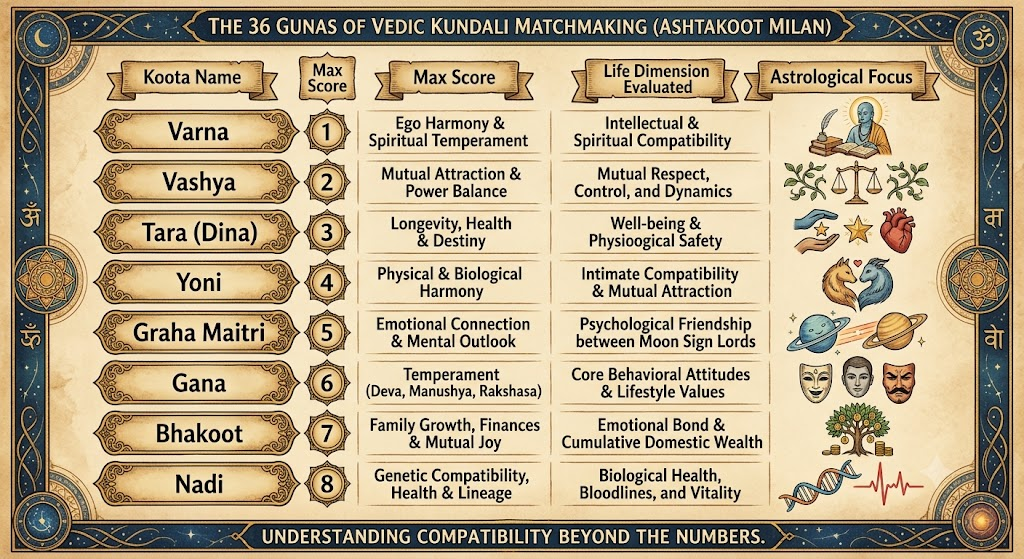
The foundational layer of Vedic marriage compatibility is the Ashtakoota system, derived from the position of the Moon (Chandra) in each partner's birth constellation (Nakshatra). A total of 36 points (Gunas) are distributed across eight distinct life dimensions (Kootas):
How to Interpret the Final Score
- Below 18 Gunas: Not recommended under classical Ashtakoot rules due to fundamental temperament or health friction.
- 18 – 24 Gunas: Average match. Acceptable if major doshas (Nadi and Bhakoot) are neutralized.
- 25 – 32 Gunas: Highly auspicious match. Strong mental, emotional, and physical synergy.
- 33 – 36 Gunas: Rare and exceptionally balanced cosmic pairing.
However, a high score alone does not guarantee marital bliss, nor does a low score automatically spell disaster. The real predictive precision lies in the Dosha cancellations (Dosha Bhanga).
Nadi Dosha: The 8-Point Myth and Crucial Cancellation Rules
Nadi carries the highest single weight in Ashtakoot Milan (8 points). It categorizes human constitutions into three bio-energetic temperaments rooted in Ayurveda:
- Aadi (Vata)
- Madhya (Pitta)
- Antya (Kapha)
If both partners belong to the same Nadi, zero points are awarded, indicating potential genetic conflicts or reproductive challenges. This often causes unnecessary alarm. In classical Jyotish, Nadi Dosha is canceled under several verified astrological conditions:
Recognized Nadi Dosha Exceptions:
- Same Nakshatra, Different Padas: If both partners share the same birth star but the Moon occupies different quarters (Padas), Nadi Dosha is substantially mitigated.
- Same Rashi, Different Nakshatras: If both have the same Moon sign but different constellations, the dosha stands dissolved.
- Different Rashis, Same Nakshatra: When the Nakshatra spans across two zodiac signs (e.g., Krittika in Aries and Taurus), the difference in sign lordship cancels the dosha.
- Friendly Rashi Lords: If the ruling planets of both partners' Moon signs are mutual natural friends (or identical), the severity of Nadi Dosha is neutralized.
To review your exact Nakshatra quarters and lunar degrees before worrying about Nadi, verify your charts using our Free Vedic Kundali Chart Generator.
Bhakoot Dosha: Understanding 6–8, 9–5, and 2–12 Moon Placements
Bhakoot accounts for 7 points and reflects the relative geometric relationship between the two Moon signs:
- Shadashtak (6–8 position): Associated with misaligned expectations, stress, or sudden disagreements.
- Navapancham (9–5 position): Often relates to differing approaches toward finances, dharma, or child-rearing.
- Dwidwadash (2–12 position): Can indicate unequal financial contributions, expenditure habits, or distance.
When is Bhakoot Dosha Canceled?
Bhakoot Dosha is automatically canceled if:
- Both Moon signs share the same ruling planet (e.g., Aries and Scorpio ruled by Mars, or Taurus and Libra ruled by Venus).
- The ruling planets of both Moon signs are intimate natural friends (e.g., Sun and Jupiter, or Mercury and Venus).
Anshik Manglik vs. Sampurna Manglik: Clearing the Confusion
Perhaps no planetary placement causes more confusion in matchmaking than Mangal Dosha (Kuja Dosha). Mars represents drive, assertion, aggression, and passion. When placed in the 1st, 2nd, 4th, 7th, 8th, or 12th house from the Ascendant (Lagna), Moon, or Venus, it creates Martian influence on partnerships.
[Mars Placement Matrix in Kundali]
1st House -> Temperament & personal drive
2nd House -> Speech & family integration
4th House -> Domestic peace & emotional calm
7th House -> Marriage house & life partner
8th House -> Longevity & marital bond
12th House -> Bedroom harmony & subconscious habits
Key Distinctions:
- Anshik (Partial / Mild) Manglik: Occurs when Mars is situated in houses like the 1st or 12th in a friendly or neutral sign, or receives aspects from benefic planets like Jupiter (Guru Drishti). The intensity is mild and typically levels out with maturity (often after age 28).
- Sampurna (Full) Manglik: Occurs when Mars is heavily afflicted in the 7th or 8th house without any benefic relief, placed in enemy signs, or conjoined with Rahu/Saturn.
Primary Mangal Dosha Cancellations:
- Mars is in its own sign (Aries, Scorpio) or exalted in Capricorn.
- Mars is in the 1st house in Aries, 4th house in Scorpio, 7th house in Capricorn, or 8th house in Sagittarius.
- The prospective partner has Saturn, Rahu, or Mars placed in corresponding houses (1st, 4th, 7th, 8th, or 12th), naturally counterbalancing the planetary heat.
For a deeper exploration of Kuja Dosha nuances and traditional remedies, explore our comprehensive Vedic Marriage Compatibility and Guna Milan Guide.
Looking Beyond Ashtakoota: The Navamsa (D9) Chart
Ashtakoot Milan evaluates only the Moon's placement. An authentic Vedic assessment requires analyzing the broader birth chart (D1) and the Navamsa Chart (D9), which serves as the micro-zodiac of marriage and inner dharma.
An experienced astrologer evaluates:
- The 7th House and 7th Lord: Are benefics like Jupiter, Mercury, or Venus influencing the house of union, or is it hemmed by malefics (Papkartari Yoga)?
- Venus (Shukra) & Jupiter (Guru): Karakas for marriage and commitment. Their strength in D9 indicates the lasting quality of emotional bonds.
- Vimshottari Dasha Sequences: Even if charts match at 32 Gunas, running contradictory or challenging Mahadashas (such as active 6th, 8th, or 12th lord periods) can generate external pressures on the couple.
4-Step Action Checklist for Modern Couples
Before taking life-changing marital decisions, follow this structured approach:
- Calculate Precise Birth Time: Accurate Ascendant and D9 charts require birth time precision within a few minutes. Check local sunrise and planetary alignments on the Daily Panchang.
- Run an Ashtakoot Score: Check the base 36 Gunas to understand temperamental baselines.
- Verify Cancellation Rules: Never reject a prospective match on a raw Nadi or Bhakoot score without confirming whether sign lordships or Nakshatra padas cancel the flaw.
- Assess Planetary Transits (Gochara): Understand current planetary cycles and sign dynamics via the Daily Rashifal to ensure timing (Muhurta) supports new relationship milestones.
Check Your Compatibility Today
Curious about how your birth charts align? Use the KundaliX Marriage Compatibility Analyzer to receive an instant, multi-layered report complete with Guna scores, cancellation logic, and planetary placements.