

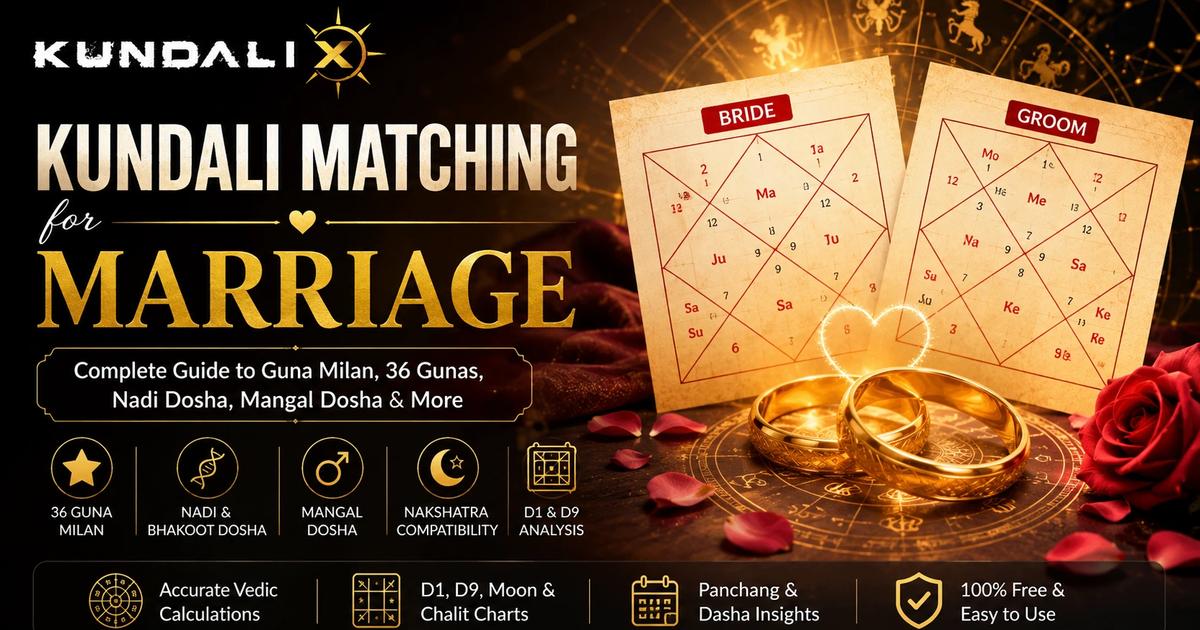
Marriage is one of the biggest decisions in life, and in Vedic astrology, Kundali matching or Kundali Milan is traditionally used to examine compatibility between two people before marriage.
Instead of looking only at zodiac signs, Kundali matching compares important elements of two birth charts, including the Moon sign, Nakshatra, planetary placements, houses and traditional compatibility factors.
One of the best-known methods is Ashtakoota Guna Milan, where eight compatibility factors are evaluated for a maximum of 36 points.
But there is an important point many people miss:
Kundali matching is not simply about getting the highest possible number of gunas.
The Guna Milan score is one part of compatibility analysis. A more meaningful reading considers the broader birth charts, marriage indicators, planetary strengths, relevant doshas and the traditional astrological context.
With KundaliX, you can generate a detailed Vedic birth chart using your birth date, exact birth time and place, then explore the planetary and divisional charts that form the foundation for deeper compatibility analysis.
Check Your Kundali on KundaliX
What Is Kundali Matching?
Kundali matching is the traditional process of comparing the birth charts of two prospective partners to assess compatibility for marriage.
A Kundali, also called a Janam Kundali, Janam Patri, Birth Chart or Horoscope, represents planetary positions at the time and place of birth.
In Vedic astrology, factors such as the Moon, Nakshatra, Rashi, Lagna, planetary relationships and houses are interpreted to understand different areas of life.
For marriage, astrologers commonly examine areas related to:
- Emotional compatibility
- Temperament and personality
- Communication
- Attraction and intimacy
- Family harmony
- Long-term compatibility
- Marriage-related planetary influences
- Traditional dosha considerations
- Future timing through planetary periods
KundaliX generates a North Indian style Vedic chart and provides D1 Lagna, D9 Navamsha, Moon and Chalit charts along with Panchang information and Vimshottari Dasha calculations.
What Is Guna Milan?
Guna Milan, also called Ashtakoota Milan, is one of the most widely recognized systems of Kundali matching.
The system evaluates eight different compatibility factors, known as Kootas, with a total of 36 possible points.
The eight factors are:
KootaMaximum PointsTraditionally Associated WithVarna1Values and general compatibilityVashya2Mutual influence and attractionTara3Birth-star compatibilityYoni4Physical and instinctive compatibilityGraha Maitri5Mental friendship and communicationGana6Temperament and natureBhakoot7Emotional and relationship compatibilityNadi8Traditional health and progeny considerationsTotal36Overall Guna Milan score
The Ashtakoota system totals 36 points, with 18 traditionally treated as a commonly used threshold for an acceptable match. However, a responsible interpretation should not treat the number as an automatic yes-or-no decision because individual chart factors can add important context.
How Many Gunas Should Match for Marriage?
One of the most searched questions about Kundali Milan is:
“How many gunas should match for marriage?”
Traditionally, 18 out of 36 gunas is considered a commonly used minimum benchmark in Ashtakoota matching.
A simplified interpretation is often presented like this:
- Below 18: Lower traditional Guna Milan compatibility
- 18–24: Moderate compatibility
- 25–32: Good compatibility
- 33–36: Very high compatibility
However, this should not be interpreted as a mathematical guarantee of a successful marriage.
For example, two charts with a high Guna Milan score can still contain other factors that deserve closer examination. Likewise, a lower score does not automatically explain the complete relationship potential of two people.
That is why Guna Milan should be viewed as one layer of Kundali matching rather than the entire analysis.
Why Is Guna Milan Not the Whole Kundali?
A common mistake is to compare two Kundalis, see “28/36,” and immediately assume everything is perfect.
In traditional Vedic astrology, marriage analysis can go beyond the Ashtakoota score.
A broader compatibility review may consider:
1. Moon Sign
The Moon is traditionally associated with the mind and emotions. Since emotional understanding is important in marriage, the Moon's sign and placement can be relevant when comparing two charts.
2. Nakshatra
The birth Nakshatra is central to traditional Guna Milan.
There are 27 Nakshatras used in Vedic astrology, and the Moon's Nakshatra at birth becomes an important input for several compatibility calculations.
KundaliX displays Nakshatra information as part of its birth and Panchang data.
3. Seventh House
The 7th house is traditionally associated with marriage and partnerships.
Its sign, lord, planetary influences and overall condition may be examined when assessing marriage-related themes.
KundaliX's Vedic Astrology Basics guide also identifies the seventh house with relationships, marriage and business partnerships.
4. Venus and Jupiter
In traditional Vedic astrology, Venus is strongly associated with love, relationships and attraction, while Jupiter has important associations with wisdom, growth and dharma.
Their positions and relationships can therefore become part of a broader marriage analysis.
5. Navamsha Chart
The D9 Navamsha chart is particularly important in traditional Vedic astrology.
KundaliX provides a D9 Navamsha chart alongside the main D1 chart. Its own guide describes Navamsha as traditionally relevant to marriage, inner strength and the deeper promise of the birth chart.
What Is Nakshatra Matching?
Nakshatra matching is an important component of traditional Kundali Milan.
A Nakshatra is the lunar constellation associated with the Moon's position at birth. Vedic astrology works with 27 Nakshatras, and the birth Nakshatra is used in several traditional compatibility calculations.
Nakshatra-based matching can be used to understand traditional compatibility themes involving:
- Temperament
- Emotional patterns
- Attraction
- Communication
- Nature and behavior
- Traditional Guna Milan factors
This is why simply comparing two Sun signs is not the same as performing a complete Kundali matching for marriage.
What Is Nadi Dosha in Kundali Matching?
Nadi Dosha is one of the most discussed topics in Kundali matching.
Nadi is the eighth Koota in the Ashtakoota system and carries the highest allocation of 8 points.
Traditional Guna Milan systems classify Nakshatras into three Nadi categories and use them as part of compatibility assessment.
Because Nadi carries eight points, a mismatch can significantly affect the total Guna Milan score.
However, people often become unnecessarily anxious after seeing the phrase “Nadi Dosha.”
A traditional compatibility assessment may require looking at the broader horoscope rather than judging the entire relationship from one label alone.
This is particularly important because Kundali matching is intended to compare the overall compatibility of two birth charts rather than reduce two people to a single score.
What Is Bhakoot Dosha?
Bhakoot Dosha, sometimes called Bhakoot Koota Dosha, is another major factor in Ashtakoota matching.
Bhakoot carries 7 points out of 36, making it one of the more influential Kootas in the traditional Guna Milan system.
It is assessed using the relationship between the Moon signs of the two individuals.
Because Bhakoot can influence the total Guna Milan score considerably, it often becomes an important part of marriage compatibility discussions.
However, as with Nadi Dosha, the broader chart context matters when interpreting traditional astrological combinations.
What Is Mangal Dosha?
Mangal Dosha, also known as Manglik Dosha, is one of the most searched marriage-related concepts in Vedic astrology.
It is traditionally associated with certain placements of Mars in a person's birth chart.
Because Mars represents qualities such as energy, action, courage and intensity in Vedic astrology, certain placements are traditionally interpreted as creating challenges that should be considered in marriage matching.
This is why many families specifically ask:
“Is the bride Manglik?”
“Is the groom Manglik?”
“Can a Manglik marry a non-Manglik?”
The answer should not be reduced to a simple internet rule.
A proper chart-based interpretation considers the actual planetary placement, relevant houses, aspects, sign, strength of Mars and traditional cancellation or balancing principles used within the chosen astrological system.
Current online astrology discussions also show continued interest in questions around Mangal Dosha cancellation, marriage delay and Manglik/non-Manglik compatibility.
Can a Manglik Person Marry a Non-Manglik Person?
This is one of the most common questions asked before marriage.
Traditional astrology does not necessarily reduce this question to:
Manglik + Non-Manglik = Bad Match
The complete birth charts should be considered.
Factors such as the position and strength of Mars, other planetary influences, and traditional cancellation or mitigation rules may be examined.
Therefore, someone should avoid rejecting a marriage proposal solely because one online calculator displays a “Manglik” label.
The right approach is to understand why the condition is being identified and what the complete chart indicates.
Kundali Matching for Love Marriage
Kundali matching is not limited to arranged marriages.
People in relationships also use birth-chart compatibility to explore traditional astrological questions such as:
- Are our personalities compatible?
- What does our Moon-sign compatibility suggest?
- How strong is our Guna Milan?
- Is there Nadi Dosha?
- Is there Bhakoot Dosha?
- Is either partner Manglik?
- What does the D9 Navamsha indicate?
- Are there traditional marriage-related planetary combinations?
- What do the current Dashas suggest?
For couples considering marriage, Kundali matching can therefore become a structured way to explore traditional compatibility themes rather than simply relying on zodiac-sign matching.
Kundali Matching for Arranged Marriage
In arranged marriage, families often compare the birth details of the bride and groom before moving forward.
The traditional process may include:
- Birth date comparison
- Exact birth-time verification
- Birth-place calculation
- Rashi and Nakshatra identification
- Guna Milan
- Nadi and Bhakoot analysis
- Mangal Dosha analysis
- D1 chart comparison
- D9 Navamsha analysis
- Broader marriage-related chart interpretation
This makes accurate birth information particularly important.
KundaliX allows users to enter their name, birth date, exact birth time and place and calculate the chart using a selected sidereal framework.
Why Exact Birth Time Matters for Kundali Matching
An approximate birth time can affect important chart calculations.
The Lagna, house placements and divisional charts depend on the exact birth moment and location.
KundaliX specifically asks for birth date, birth time and birthplace and resolves coordinates and timezone information to generate the chart.
For marriage matching, using accurate information for both people makes the comparison more useful.
When possible, use:
- Correct date of birth
- Exact recorded birth time
- Correct birth city or location
Rather than relying on an approximate time such as “around 8 PM.”
D1 and D9: Why Both Charts Matter
The D1 Lagna chart is the primary birth chart.
The D9 Navamsha chart is a divisional chart traditionally associated with marriage and deeper chart interpretation.
KundaliX provides both charts directly in its Vedic chart report.
This creates an important distinction:
Kundali matching should not always stop after reading the Guna Milan score.
The D1 chart can provide the foundation, while the D9 may offer additional traditional marriage-related context.
Can Vimshottari Dasha Help With Marriage Analysis?
Another interesting layer of Vedic astrology is Vimshottari Dasha.
Dashas are planetary periods traditionally used for timing life events.
KundaliX calculates Vimshottari Dasha based on the Moon's Nakshatra at birth and provides Mahadasha and Antardasha information.
For marriage-related astrology, practitioners may examine whether relevant planetary periods are active when a person is entering a relationship, considering marriage or experiencing a major relationship transition.
This means two people can have promising compatibility indicators while their individual timing patterns may still differ.
Read more about this system in the KundaliX Vimshottari Dasha Guide.
What Is Ayanamsa and Why Does It Matter in Kundali Matching?
Ayanamsa is a technical concept that becomes important when calculating a sidereal Vedic horoscope.
It represents the angular difference between the tropical and sidereal zodiac systems.
Different ayanamsa values can slightly change planetary longitudes, which can sometimes affect sign or degree placements. KundaliX uses a selectable sidereal framework and provides an explanation of Lahiri and other ayanamsa approaches.
This matters because if two astrology calculators use different calculation settings, the resulting planetary positions can sometimes differ.
Read the KundaliX Ayanamsa Guide to understand why.
How to Do Kundali Matching Online
If you want to explore your birth charts before marriage, the process can start with accurate birth information.
Step 1: Generate the first Kundali
Enter:
- Name
- Date of birth
- Exact birth time
- Birth place
Step 2: Generate the second Kundali
Use the same level of accuracy for your prospective partner.
Step 3: Compare traditional compatibility factors
Look at:
- Rashi
- Nakshatra
- Guna Milan
- Nadi
- Bhakoot
- Gana
- Yoni
- Graha Maitri
- Mangal Dosha
Step 4: Go beyond the score
Review the broader birth charts, including the:
- D1 Lagna chart
- D9 Navamsha
- Moon chart
- Planetary placements
- Marriage-related houses
- Vimshottari Dasha
Step 5: Understand the result in context
Do not make a major life decision based on one number alone.
Kundali matching can provide a traditional astrological perspective, while communication, values, emotional maturity, financial expectations and mutual respect remain important real-world parts of a relationship.
What Is a Good Kundali Match?
There is no single number that can describe every relationship.
A traditional Guna Milan score is useful as a starting point, but a stronger compatibility analysis considers the complete picture.
A potentially useful checklist includes:
Emotional compatibility:
How do the Moon signs and relevant planetary placements compare?
Temperament:
What does Gana and other traditional compatibility factors indicate?
Attraction:
What does Yoni and Venus-related symbolism suggest within the chosen system?
Long-term relationship themes:
What do the 7th house, its lord and D9 suggest traditionally?
Dosha considerations:
Are Nadi, Bhakoot or Mangal Dosha present, and are there traditional mitigating factors?
Timing:
What do the individual Dashas indicate?
This approach is much more informative than asking only:
“How many gunas matched?”
Common Kundali Matching Mistakes
Mistake 1: Looking only at the Guna score
A score is useful, but it is not the complete horoscope.
Mistake 2: Using inaccurate birth time
Birth time can influence Lagna and house-based calculations.
Mistake 3: Rejecting someone immediately because of Nadi Dosha
Nadi is important in traditional matching, but broader chart interpretation may also matter.
Mistake 4: Assuming Manglik always means marriage problems
Mangal Dosha requires chart-specific interpretation rather than a simplistic label.
Mistake 5: Comparing only Sun signs
Marriage compatibility is much more detailed than checking whether two zodiac signs “match.”
Mistake 6: Using different calculation systems unknowingly
Different ayanamsa settings can produce differences in planetary positions. Understanding the calculation system helps when comparing charts.
Kundali Matching vs Zodiac Sign Compatibility
These terms are often used interchangeably, but they are not the same.
Zodiac compatibility usually means comparing Sun signs or broad zodiac characteristics.
Kundali matching involves a complete birth chart and may include:
- Moon sign
- Nakshatra
- Lagna
- Planetary placements
- Ashtakoota Guna Milan
- Nadi
- Bhakoot
- Mangal Dosha
- D1 chart
- D9 Navamsha
- Dashas
Therefore, if someone says:
“Our zodiac signs match, so our Kundalis should match.”
That conclusion is too simplistic.
Frequently Asked Questions About Kundali Matching
Is 18 Guna enough for marriage?
18 out of 36 is traditionally used as a common minimum benchmark in Ashtakoota Guna Milan. However, the total score should be interpreted alongside the broader charts rather than used as an automatic marriage decision.
Is 24 Guna a good match?
A score around 24 is generally considered a moderate-to-good traditional Guna Milan result, but the complete birth charts still provide important context.
What is the maximum score in Kundali Milan?
The maximum score in Ashtakoota Guna Milan is 36 points.
What happens if Nadi does not match?
A Nadi mismatch can significantly reduce the Guna Milan score because Nadi carries 8 points. Traditional astrology also considers broader chart factors and possible mitigating conditions.
Can a Manglik marry a non-Manglik?
Traditional astrology does not necessarily treat every Manglik/non-Manglik pairing as automatically unsuitable. The actual Mars placement and the complete chart should be considered.
Is Kundali matching necessary for marriage?
Kundali matching is a traditional Vedic astrology practice, not a universal requirement. Couples and families may choose to use it as one source of guidance before marriage.
Can Kundali matching predict a successful marriage?
Astrology can be used to explore traditional compatibility themes, but a Guna score should not be treated as a guarantee of relationship success or failure.
Does Kundali matching work for love marriage?
Yes. Couples in love can also compare their Kundalis to explore traditional compatibility factors before marriage.
Which chart is important for marriage?
The D1 birth chart is fundamental, while the D9 Navamsha is traditionally important for deeper marriage-related analysis. KundaliX provides both.
Does birth time matter for Kundali matching?
Yes. Accurate birth time can affect the Lagna, houses and divisional chart calculations, making it important for detailed chart analysis.
Start Your Kundali Analysis with KundaliX
Before making a major relationship decision, start with accurate birth information and understand what your chart actually contains.
KundaliX provides a free Vedic astrology chart generator with:
- North Indian style Kundali
- D1 Lagna Chart
- D9 Navamsha Chart
- Moon Chart
- Chalit Chart
- Nakshatra information
- Panchang details
- Planetary positions
- Vimshottari Dasha
- Sidereal calculation options
Generate your chart and explore the foundations of your Kundali before moving into deeper compatibility analysis.
Generate Your Free Kundali on KundaliX →
Final Thoughts
Kundali matching for marriage is much more than finding a number out of 36.
Guna Milan can provide a traditional first layer of compatibility analysis, while Nakshatra, Moon sign, Nadi, Bhakoot, Mangal Dosha, the 7th house, D1 chart, D9 Navamsha and Vimshottari Dasha can add further context.
The most useful approach is to look at the complete Kundali rather than one score or one dosha.
And beyond astrology, a strong marriage is built through communication, trust, shared values, respect and the willingness of two people to grow together.
Use KundaliX to generate your birth chart, understand your planetary placements and explore your Vedic astrology profile.
Your birth chart tells a story. Start reading it with KundaliX.